


Remote, one location
Screen share or view-only access, one site, one point-of-sale system. Additional locations are a separate review, quoted first.
One connected platform
Your business, beautifully connected.
Every detail, connected. Explore all features.
Built around your business
Your business has its own rhythm.
Ready to begin? Get started online.
Explore at your own pace
See the possibilities. Find your next step.
Looking for a definition? Browse the glossary.

One connected platform
Platform

Built around your business
Solutions
 Start with a fresh perspective.See how your website and listings show up online, and where there’s room to improve.Get your free audit All solutions

Explore at your own pace
Resources
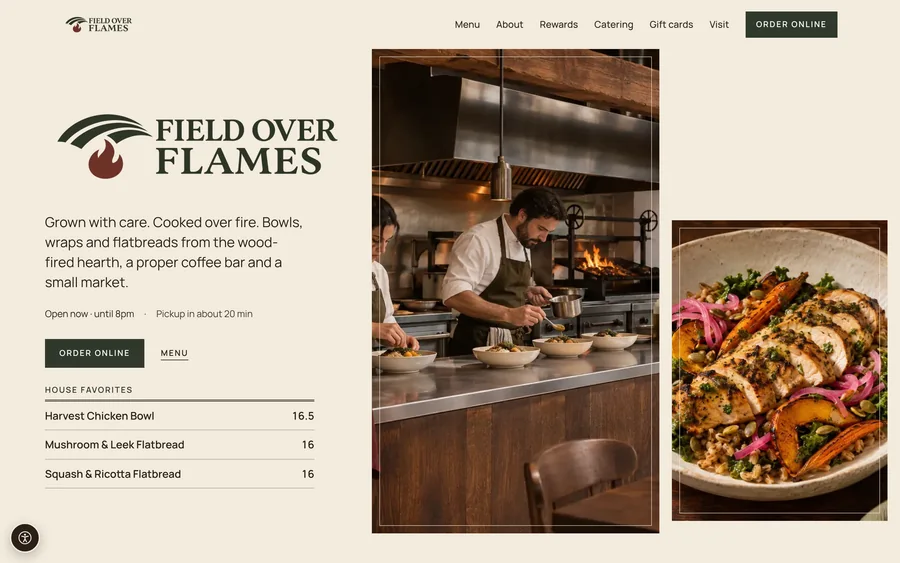 Your brand, elevated.Explore the curated looks in the visual studio and find your starting point.Explore the visual studio Explore the glossary
The smallest useful step
Most owners we speak to are not looking for a project. They have a system that mostly works, a nagging feeling that it is configured badly, and no appetite for another vendor conversation that ends in a proposal.
This is the version of that conversation with a floor under it. We look at your settings and how the place runs, and you get a prioritized list of what to fix. You can hand that list to your manager, to your platform onboarding contact, or to us. All three are fine.
Tell us what is happening on your floor →What is a POS health check and what do I get out of it?
A remote review of your point-of-sale settings and workflows, ending in a written, prioritized action list. It is ordered by what it is costing you now, what is slowing your staff down, and what is fine and should be left alone. It is yours to act on with anyone. There is a fixed price and it is on the pricing page.
One remote session, a screen share or view-only access, and a couple of hours of somebody looking at your configuration who has seen a few hundred of them. Then a written list.
There is no discovery phase, no stakeholder workshop, and no proposal at the end unless you ask for one. It is deliberately small because the reader we wrote it for has been burned by something that started small and did not stay that way.
It works on Square, Toast, Clover and Shopify POS. It works on a system somebody else set up, on a system you set up yourself at midnight three years ago, and on a system you inherited when you bought the place.
You are allowed to buy the smallest thing first. We would rather you did.
The specifics vary by platform, but the shape of the review is consistent. These are the things that turn out to be wrong most often, roughly in the order they cost money.
A written list, in three buckets, in plain language. Not a slide deck.
Costing you money now. The tax error, the modifier that is not charging, the item invisible online, the discount structure that is not being reported. These come with what we think the fix is and how long it should take.
Slowing your staff down. The register layout, the missing defaults, the permission set that forces a manager over three times a shift. Less urgent, more felt.
Leave it alone. The part most reviews skip. Plenty of what we look at is fine, and saying so is the difference between a review and a sales document. If your setup is good, the list will be short and we will tell you that plainly.
Each item says whether it is something your manager can do, something the platform support team will do for free, or something that genuinely needs configuration work. Quite a lot of it falls in the first two.
Fair question, and the honest answer is a little against our own interest. This is the cheapest thing on our rate sheet, and a meaningful share of the time it ends with us not selling anything else. Somebody takes the list, spends a Sunday on it, and their system is fine.
We keep selling it anyway for two reasons. The first is that we would rather be the company that told you the truth for a small amount than the one that quoted a migration you did not need. We talk people out of migrations regularly and it costs us real money each time.
The second is that it is a fair way for both of us to find out whether we work well together, before anybody has committed to a project. You get a list either way, which means the worst case is still useful.
You book it, we send one short intake asking what is annoying you and who uses the system. You give us view-only access or we sit on a screen share, whichever you prefer. Nothing is changed during the review unless you ask us to fix something in front of you, in which case we will.
The list arrives afterward, in writing. If you gave us access, you remove it in the platform permissions when we are done, and we will remind you to.
It is remote. That is not a hedge, it is genuinely the right shape for this work, because configuration lives in the back office and not on the floor. If your problem is that the printer drops off the Wi-Fi at seven every evening, that is a site visit and a different conversation, and we will say so rather than take the booking.
If you want us to do the work, the health check is not wasted effort. The review is the first half of a configuration project, so the work already done is credited against it rather than charged twice.
If you want to do it yourself, take the list. There is no clause anywhere saying you have to hire us, and nothing in the document is deliberately withheld to force a follow-up. That would make the product dishonest and it is a small product; it is not worth being dishonest over.
And if the list points somewhere else entirely, at your Google listing, at your ordering link, or at a website that is sending people to the wrong place, we will say that instead. The point of the exercise is to find the thing that matters, not to find work.
Stated in numbers, so nobody has to guess where it ends.
Small, bounded, and deliberately so. There is a fixed price for it and it is on the pricing page.
Screen share or view-only access, one site, one point-of-sale system. Additional locations are a separate review, quoted first.
Configuration as it exists, and how your team uses it day to day. What we can see in the back office and what you tell us about the floor.
Written, in three buckets: costing you money, slowing you down, and leave it alone. Each item labeled by who can do it.
We review. We do not reconfigure during the session unless you specifically ask, and then only with you watching.
The list is your document. Give it to your manager, your platform onboarding contact, or another vendor. There is no obligation attached to it.
Anything past these limits is quoted before it starts, never after. Every published price is on one page.
Be honest with me
Then the list is short and says so, and that is a legitimate outcome we have delivered more than once. You have bought certainty about something that was nagging at you, which is worth something on its own. We are not going to invent findings to justify the invoice.
No. A screen share works, and it is what nervous owners usually choose, which is entirely reasonable. If you do grant access, view-only is enough for most of the review, and you remove it in the platform permissions the moment we are finished. We will remind you to.
Square, Toast, Clover and Shopify POS, which covers the large majority of independent restaurants and shops. If you run something else, tell us what it is before you book. We will either say yes or say that we do not know it well enough to charge you for an opinion.
The session is short. The written list follows within one to two business days, with a specific date given when we book, not a vague soon. If we are going to be late, you hear it from us before the deadline rather than after.
It is a paid product with a deliverable, which is the honest way to make sure it is not. Nobody pays for a sales call. If the review ends with a recommendation to hire us, it will be a specific one with a number attached from the published rate sheet, and you are free to take the list elsewhere.
Tell us what system you run and what has been bothering you about it. If a health check is not the right thing, we will say so before you book, which has happened often enough that it is worth writing down.
Platform pricing and features change; where a platform does not publish a number we say so rather than guessing.
Shop & Table connects with supported commerce platforms. Square, Toast, Clover and Shopify are trademarks of their respective owners.

You are leaving shopandtable.com
We link out when a vendor’s own documentation or a regulator is the right source. The site you are about to visit has its own terms, its own privacy practices and its own content; none of it is covered by our Privacy Policy or Terms of Service, and a link is not an endorsement. It will open in a new tab.